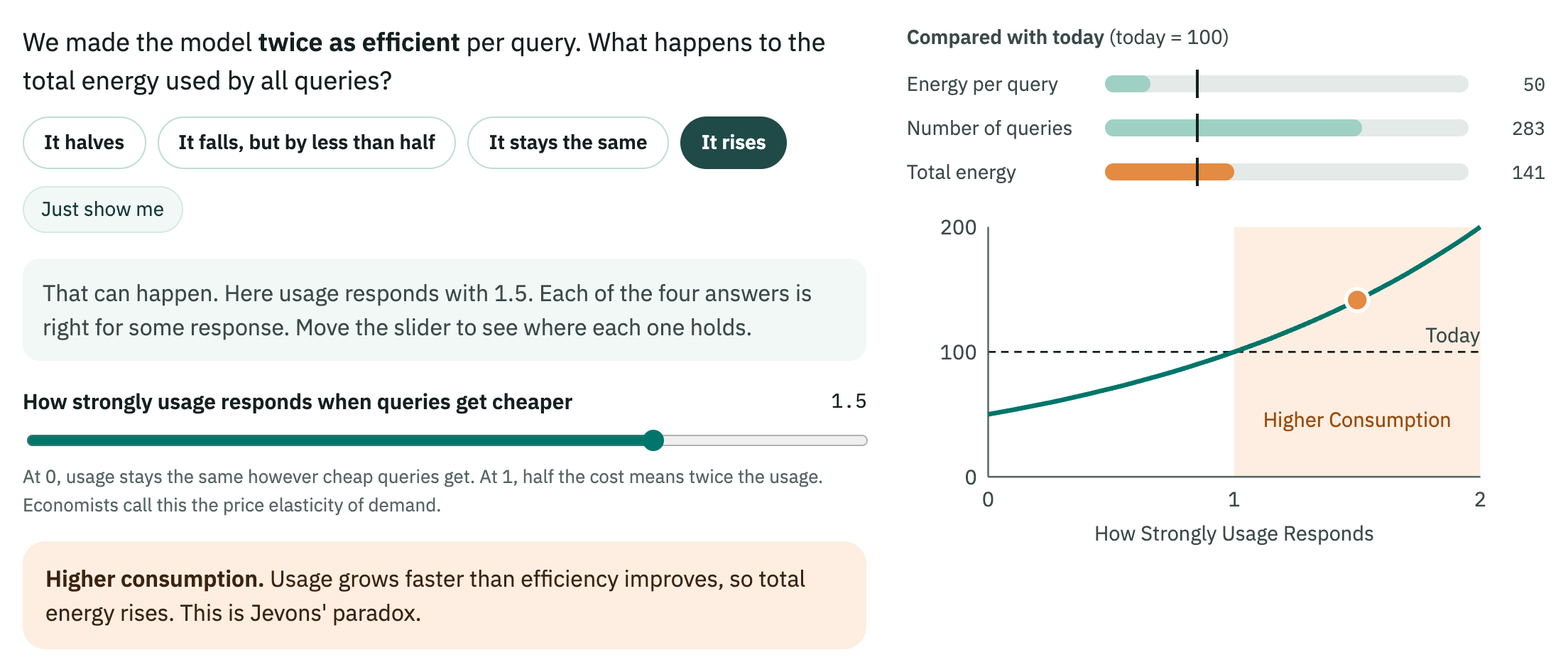
Efficiency is often presented as the answer to AI’s energy use. A model that needs half the energy per query also makes each query cheaper, and cheaper queries tend to be used more. Guess what a twice as efficient model does to the total energy, then see when the promise of saving holds.
The interactive demo needs JavaScript.
The model. Usage responds to the cost of a query with a constant strength e, and the cost of a query is taken to follow its energy. Total energy is then 2e − 1 times today’s. It falls below today’s level only while e is smaller than 1.
In reality. This is a textbook simplification. How strongly the use of AI responds to cheaper queries is debated and cannot be known in advance, so it has to be measured. The effect is known as Jevons’ paradox. William Stanley Jevons first described it for coal in The Coal Question (1865).