News

Papers, people, projects and opportunities from the lab.

Latest

2 Nov 2026 · Welcome

We welcome Federico Di Valerio for a PhD internship

Read more: We welcome Federico Di Valerio for a PhD internship

We are happy to welcome Federico Di Valerio for a PhD internship in the lab. Federico is a PhD candidate at Sapienza Università di Roma (opens in a new tab), Italy, supervised by Prof. Roberto Capobianco, and will be staying at OWL-ML in Bremen until April 2027.

Federico’s research lies at the intersection of continual learning and explainable AI. During his PhD visit at OWL-ML, he will work on explainability for continual learning and on multimodal continual learning, in particular how to weigh different modalities when constructing a memory. Since modalities can differ drastically in cost, the guiding question is how much one modality is worth storing over another.
arXiv 2026

1 Nov 2026 · Paper

New preprint: Spectral Signatures of Memorization Basins in Diffusion Trajectories

Read the paper →: New preprint: Spectral Signatures of Memorization Basins in Diffusion Trajectories
Read more: New preprint: Spectral Signatures of Memorization Basins in Diffusion Trajectories

Our new preprint “Spectral Signatures of Memorization Basins in Diffusion Trajectories (opens in a new tab)” is now online.

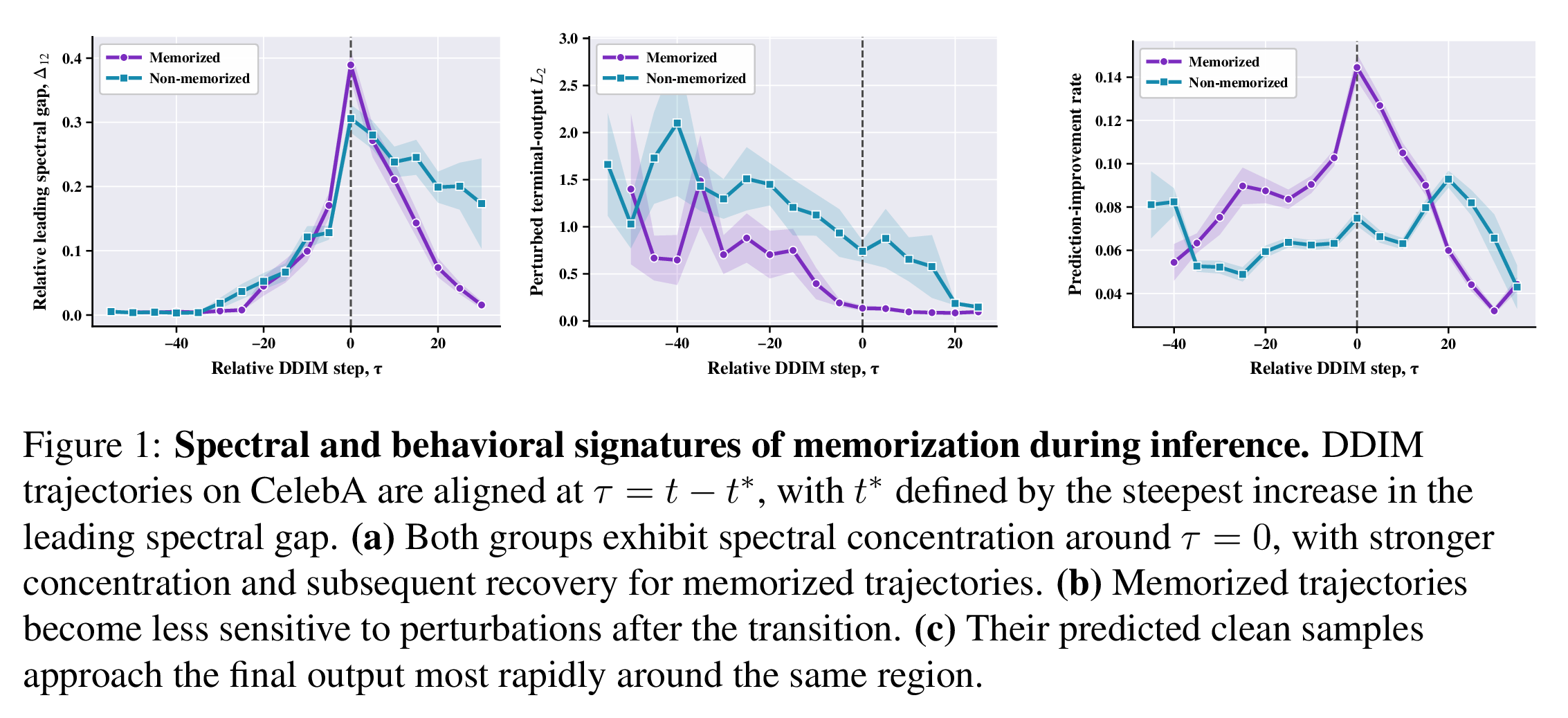
Diffusion models are known to reproduce individual examples from their training data as a form of memorization with implications for generalization, privacy, and downstream use. Recent work demonstrated that memorized training samples reside inside contiguous regions of the data/latent space known as basins of memorization – once a denoising trajectory enters a basin, under finite perturbations it irreversibly reproduces a memorized example. Prior empirical work on such basins in trained models has primarily focused on classifier-free guidance based detection and mitigation strategies in text-to-image models, leaving basin entry and their formation largely uncharacterized. In this paper, we present a geometric characterization of memorization basins for conditional, unconditional, and rectified-flow-based diffusion models. We observe a characteristic signature in the local spectrum of the function geometry that distinguishes basin entry: the emergence of a dominant singular mode followed by a sharp spectral recovery. This signature appears at two timescales: along denoising trajectories during inference and over the course of training. We further investigate whether these geometric signatures can be used to intervene on memorization. During training, we suppress memorization by acting on the dominant mode. At inference, we develop methods to identify trajectories entering memorization basins and steer them away. We find that these interventions remain effective even with low-dimensional approximations of the underlying geometry, and demonstrate that geometry-informed steering extends to large-scale text-to-image diffusion models. Together, our results corroborate that local spectral geometry provides a common basis for characterizing memorization and for suppressing, detecting, and steering away from it across training and generation.

For more information, read the full paper (opens in a new tab).

arXiv 2026

16 Oct 2026 · Paper

New preprint: Time to Fake It: Continual Machine Learning Intensifies Unfairness in Deepfake Detection

Read the paper →: New preprint: Time to Fake It: Continual Machine Learning Intensifies Unfairness in Deepfake Detection
Read more: New preprint: Time to Fake It: Continual Machine Learning Intensifies Unfairness in Deepfake Detection

Our new preprint “Time to Fake It: Continual Machine Learning Intensifies Unfairness in Deepfake Detection (opens in a new tab)” is now online.

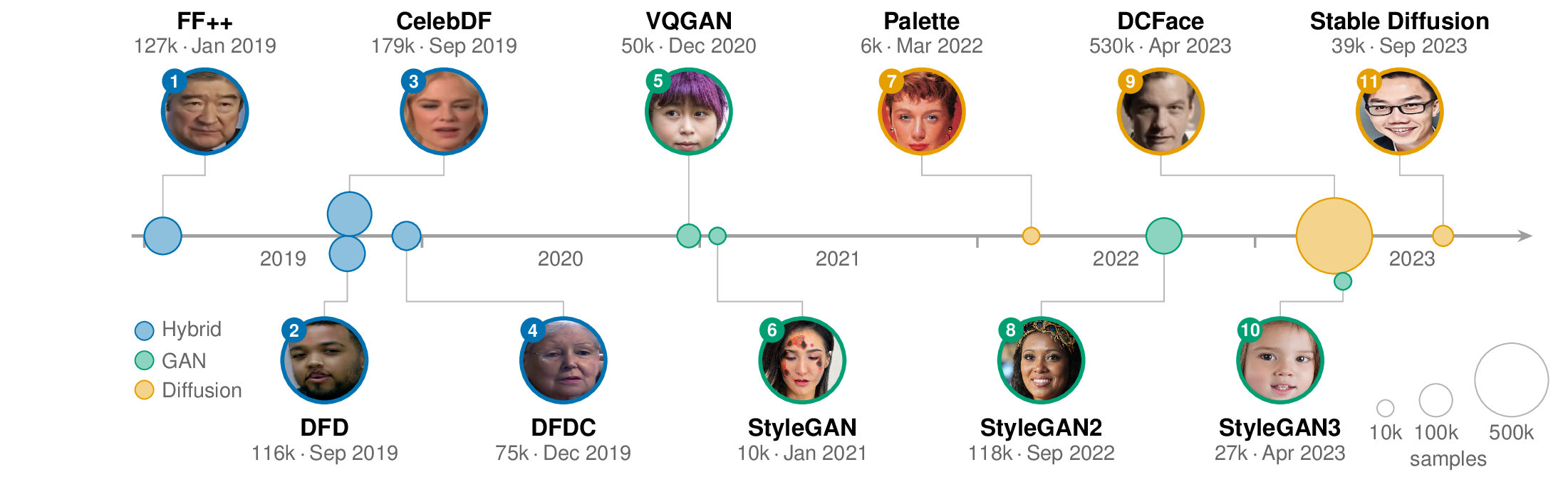
Deepfake detectors safeguard against misinformation, rendering their failures as much a societal as a technical concern. As generators constantly evolve, detectors trained on static datasets miss newly arising threats, while progressive training interferes catastrophically. Yet, mitigating forgetfulness in terms of accuracy, the prevalent focus of continual learning (CL), is insufficient to reflect real-world impact. We therefore scrutinize the effects of CL methods with respect to evolving fairness. To this end, we analyze four dimensions of fairness across diverse demographics for detectors trained progressively on a chronological sequence of 11 real-world deepfake generation methods. Tracking fairness metrics over time, we expose non-trivial interplays between performance and fairness that depend on both the choice of CL algorithm and demographic intersections. We find accuracy degradation to typically exacerbate unfairness and, conversely, fairness improvements to remain scarce over time. Dissecting the CL method families (rehearsal, prompts, regularization), we observe that inequitable forgetting is not explained by underrepresentation alone, but likely entangled with representation learning. We thus issue a call to action for CL methods to take social outcomes into account when balancing the stability-plasticity tradeoff.

The code is on GitHub (opens in a new tab). For more information, read the full paper (opens in a new tab).

15 Sep 2026 · Welcome

Peter Stegmaier has joined as a PhD candidate

Profile →: Peter Stegmaier has joined as a PhD candidate
Read more: Peter Stegmaier has joined as a PhD candidate

We are more than happy to welcome Peter Stegmaier as a new PhD candidate in the OWL-ML lab. Peter is supervised jointly with Hochschule Bremen (opens in a new tab), with Prof. Dr.-Ing. Uta Bohnebeck as co-supervisor.

In his PhD, Peter will develop trustworthy AI for marine underway observations: the continuous, high-resolution measurements that German research vessels record along their ship track. Quality control of these data still relies on rule-based checks and manual expert review, which scale poorly as data volumes grow. Peter will build a quality control support system in which anomaly detection points experts to suspicious segments, explainable evidence helps them tell measurement artifacts from real environmental variability, and their feedback continually adapts the model to new cruises and vessels without forgetting what it has learned before. We are looking forward to inspiring future research.

Best Paper Honorable Mention · FAccT 2026

29 Jun 2026 · Award · FAccT 2026

Making a Name for Myself: On Academic Naming Policies and their Impact has received a Best Paper Honorable Mention at FAccT 2026

Read the paper →: Making a Name for Myself: On Academic Naming Policies and their Impact has received a Best Paper Honorable Mention at FAccT 2026
Read more: Making a Name for Myself: On Academic Naming Policies and their Impact has received a Best Paper Honorable Mention at FAccT 2026

We are very honored that the work “Making a Name for Myself: On Academic Naming Policies and their Impact (opens in a new tab)”, which was co-authored with multiple Queer in AI scholars, has received a Best Paper Honorable Mention (opens in a new tab) at the ACM Conference on Fairness, Accountability, and Transparency (FaccT 2026) (opens in a new tab)

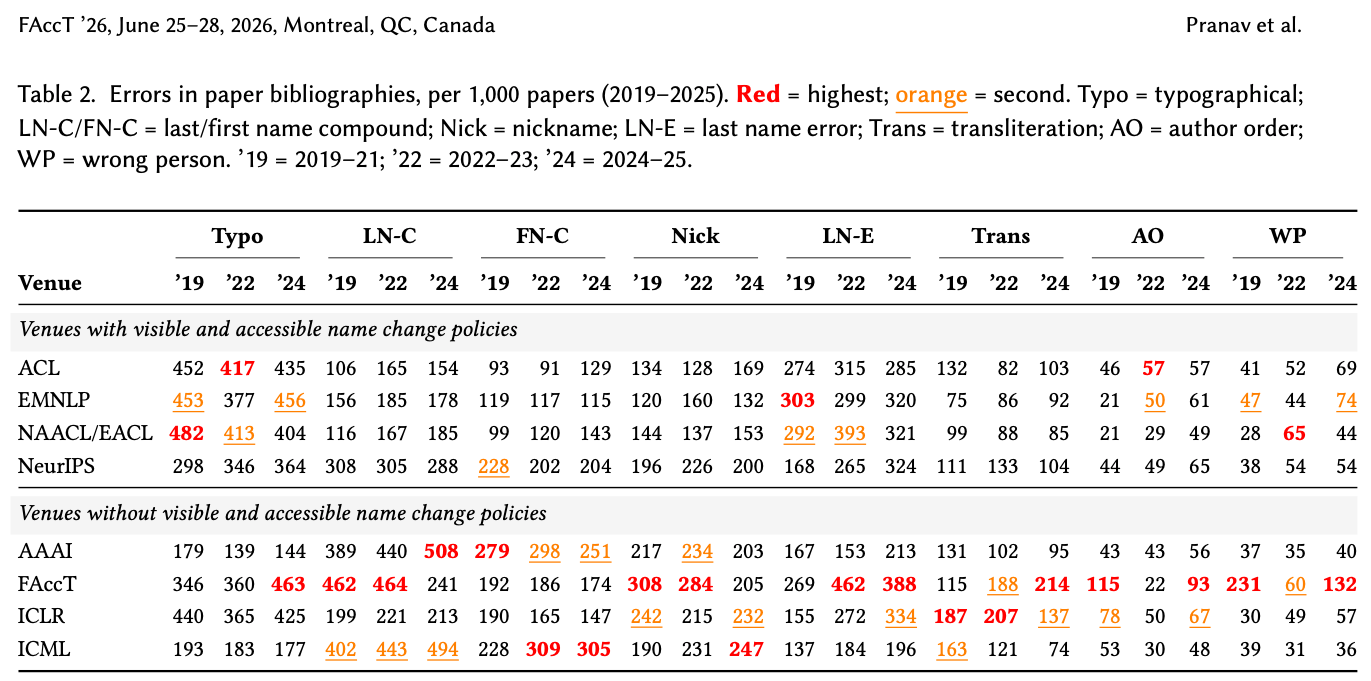
In summary, the paper is about why names matter, how academic naming practices impact researchers, why name change policies are important, how people benefit from it and what there still is to do. In practice, we took a mixed-methods approach and i) surveyed and interviewed people who changed their names, ii) performed a large-scale quantitative analysis of different kinds of citations errors across ML venues (NeurIPS, ICLR, ICML, AAAI, ACL, NAACL, EMNLP, FAccT) over the past 6 years. For the former, only 11.1% achieved complete removal of their deadname, and many publishers took prolonged periods of time to report name changes. For the latter, we find that naming errors in citations have several reasons (ranging from mere typos, to compound name errors, transliterations, wrong person attribution, citing the wrong person, and ignoring name changes), but that venues with active policies surrounding name change and correction feature overall fewer errors. As our name is often our brand in academia, this should be a reminder that there is still a lot to improve and why community driven advocacy remains essential.

For more information, read the full paper (opens in a new tab).

Earlier

May 2026

18 May · Welcome

We welcome Zwe Nyan Zaw & Pongsakorn Arayasak for a summer internship

Read more: We welcome Zwe Nyan Zaw & Pongsakorn Arayasak for a summer internship

We are happy to welcome Zwe Nyan Zaw and Pongsakorn Arayasak to the lab as undergraduate research summer interns from mid May to end of July. Zwe and Pongsakorn were both successful in a competitive application to follow in the footsteps of many students through the strategic partnership between University of Bremen and Mahidol University (opens in a new tab), Thailand.

During the stay at the OWL-ML lab, they will jointly be working on enhancing scientific question-answering and effectively deploying large language models to extract information about continual learning approaches from public papers.

15 May · Welcome

Gabriel Storch has joined as a PhD Candidate

Read more: Gabriel Storch has joined as a PhD Candidate

We are more than happy to welcome Gabriel Storch as a new PhD candidate in the OWL-ML lab.

Gabriel has previously completed an international M.Sc. in Data Science at the Hamburg University of Technology and will now be pursuing his PhD within the DFG Research Training Group (RTG) KD²School (opens in a new tab) . In this RTG, KIT is collaborating with the Universities of Bremen and of Oldenburg to research the design of biosignal-adaptive systems for decision-making processes in economic contexts as well as in private and professional life. Here, Gabriel will pursue interdisciplinary questions on adaptivity mechanisms at the interface of biosignal foundation models, including methods such as in-context learning, multimodal continual learning, and rapidly adaptability memory.

April 2026

30 Apr · Paper

Modular Memory is the Key to Continual Learning Agents got accepted as a spotlight position paper at ICML 2026

Read more: Modular Memory is the Key to Continual Learning Agents got accepted as a spotlight position paper at ICML 2026

In October 25, we had the pleasure to co-organize the Schloss Dagstuhl – Leibniz-Zentrum für Informatik (LZI) (opens in a new tab) seminar on “Deep Continual Learning in the Foundation Model Era” with Joost van de Weijer (University of Barcelona), Tinne Tuytelaars (KU Leuven), and Christopher Kanan (University of Rochester), where we discussed the future of continual learning with a group of world-class researchers. Today, we are happy that our jointly developed roadmap, following a commonly identified theme of modular memory as the central element to unlock continual adaptation at scale, has been accepted as a spotlight position paper at ICML 2026!

Specifically, in our paper: “Modular Memory is the Key to Continual Learning Agents (opens in a new tab)”, we outline the need to combine the strengths of In-Weight Learning and the emerging capabilities of In-Context learning through design of a modular memory framework. Thanks to everyone who contributed to this work! In particular to Vaggelis Dorovatas (Toyota Europe) as the lead author and OWL-ML’s Malte Schwerin as the second author, and to Rahaf Aljundi (Toyota Europe) & Jonghyun Choi (Seoul National University), for the joint efforts in coordinating the paper.

For more information, read the full paper (opens in a new tab).

February 2026

5 Feb · Funding

DFG Research Training Group KD2School – 2nd Funding Period approved

Read more: DFG Research Training Group KD2School – 2nd Funding Period approved

We are excited to announce that the DFG Research Training Group (RTG) KD²School (opens in a new tab) will receive funding for another five years. In this RTG, KIT is collaborating with the Universities of Bremen and of Oldenburg to research the design of biosignal-adaptive systems for decision-making processes in economic contexts as well as in private and professional life.

In the upcoming second funding period, where OWL-ML is a new member, this goal will be pursued through an interdisciplinary approach combining psychology, neuroscience, economics, information systems, and computer science – which also enables young researchers to gain excellent qualifications.

Further information is also available via the official press release by DFG (opens in a new tab)

2 Feb · Welcome

We welcome Joana Vale Sousa for a PhD internship

Read more: We welcome Joana Vale Sousa for a PhD internship

We are happy to welcome Joana Vale Sousa for a PhD internship in the lab, supported by the Erasmus program. Joana is a PhD candidate at INESC TEC Porto (opens in a new tab), Portugal, and will be staying at OWL-ML in Bremen for 6 months until the end of July 2026.

Joana works on continual learning in the context of medical imaging. More broadly, she is interested in how to design experience replay mechanisms and drift detectors, while simultaneously catering to application needs and requirements. During her PhD visit period at OWL-ML she will continue on this thread and bring our algorithmic expertise to the medical domain.

January 2026

29 Jan · Paper

Beyond Binary Out-of-Distribution Detection: Characterizing Distributional Shifts with Multi-Statistic Diffusion Trajectories got accepted at AISTATS 2026

Read more: Beyond Binary Out-of-Distribution Detection: Characterizing Distributional Shifts with Multi-Statistic Diffusion Trajectories got accepted at AISTATS 2026

Our paper “Beyond Binary Out-of-Distribution Detection: Characterizing Distributional Shifts with Multi-Statistic Diffusion Trajectories (opens in a new tab)” has been accepted for publication at the 29th International Conference on Artificial Intelligence and Statistics: AISTATS 2026 (opens in a new tab). It will be presented at the conference in early May in Tangier, Morocco.

In the paper, we ask the question whether out-of-distribution detection can go beyond a typically formulated binary question. That is, rather than wanting to only know whether a new datapoint is out-of-distribution, we would also like to be able to distinguish different kinds of detected shift to separate potential sources. We achieve this separation by introducing a diffusion based statistical characterization framework. In short, our framework can distinguish different kinds of out-of-distribution data by leveraging the time-signal of the diffusion process, allowing decisions to be based on unique temporal signatures rather than mere decisions based on “in” vs. “out”.

For more information, read the full paper (opens in a new tab).

Show earlier years

October 2025

28 Oct · Opportunity

Excellence Cluster "Reasonable AI" is hiring PhD candidates (deadline 16.11.25)

Closed · deadline was 16 Nov 2025
Read more: Excellence Cluster "Reasonable AI" is hiring PhD candidates (deadline 16.11.25)

The German Cluster of Excellence on “Reasonable Artificial Intelligence” (RAI) is now looking for PhD candidates to give rise to richer, more robust AI systems that inherently possess the abilities to think, learn, interact, and adapt. The cluster is structured across four labs - each looking to fill several positions.

Although the core cluster is situated at TU Darmstadt, it also unites several leading universities across Darmstadt, Bremen, Frankfurt, Saarland, Tübingen, and Würzburg. Applications are centralized in a collective call for positions.

In the application process you can choose your preferred topics and who you’d like to work with. If you apply for the “Active AI” (adaptive, interactive, lifelong agents) or “Challenging AI” (reasoning & cognitive science informed benchmark design), you can indicate your preference to work with us in the orientation phase and later also join our lab.

Apply by November 16th 2025 Research Lab Active AI Research Lab Observational AI Research Lab Systemic AI Research Lab Challenging AI

September 2025

8 Sep · Paper

"Aligning Generalisation Between Humans and Machines" has been published at Nature Machine Intelligence

Read more: "Aligning Generalisation Between Humans and Machines" has been published at Nature Machine Intelligence

Our paper “Aligning generalisation between humans and machines” is now published at Nature Machine Intelligence (opens in a new tab)! This paper has been co-authored with 25 experts in AI and cognitive science and is a product of the Dagstuhl seminar on “Generalization by People and Machines” in May 2024. We thank the many co-authors and the seminar’s organizers for this joint work.

In summary, the paper combines insights across disciplines to identify key commonalities and differences across three dimensions: notions of, methods for, and evaluation of generalization. Some key findings of the paper are:

  • Generalization is a multi-dimensional concept.
  • Humans and typical (statistical) machines generalize in complementary ways.
  • Collaborative and explainable mechanisms are key to achieving alignment in human-AI teaming.
  • Given the promise of foundation models, further research is necessary to provide guarantees and theoretical support for their generalization.
  • Weaknesses of standard (statistical) AI techniques can be mitigated by other AI families: case-to-case and analytical methods, highlighting the promise of hybrid, neurosymbolic AI.
  • The relationship between continual learning and generalization is complex but promising to explore.
  • Evaluating the many facets of generalization has improved, yet, many gaps remain.

For more information, read the full paper (opens in a new tab).

1 Sep · Paper

"Core Tokensets for Data-efficient Sequential Training of Transformers" has been accepted to the ICCV Workshop on Continual Learning in Computer Vision

Read more: "Core Tokensets for Data-efficient Sequential Training of Transformers" has been accepted to the ICCV Workshop on Continual Learning in Computer Vision

Our paper “Core Tokensets for Data-efficient Sequential Training of Transformers (opens in a new tab)” has been accepted for publication in the ICCV-W proceedings in context of the Workshop on Continual Learning for Computer Vision (opens in a new tab). The paper will be presented at the Workshop in October at ICCV in Hawaii.

In the paper, we introduce the concept of core tokensets. Whereas traditional core sets identify a subset of a dataset that yields comparable results to the full dataset, tokensets go one level deeper and find the subset of relevant tokens. For images, this breaks down to going beyond a single image being more important than another, and instead focusing on precise regions/patches of important content. In the paper we show that this helps reduce memory cost substantially (up to factor 10) in comparison to traditional core sets, when applied in various application contexts such as image classification, multi-modal image captioning and visual question answering.

For more information, read the full paper (opens in a new tab).

June 2025

16 Jun · Welcome

We welcome Andrea Fanti for a PhD internship

Read more: We welcome Andrea Fanti for a PhD internship

We are happy to welcome Andrea Fanti for a PhD internship in the lab. Andrea is a third year PhD candidate in the KRL research group at Sapienza Università di Roma (opens in a new tab), Italy, and will be staying at OWL-ML in Bremen for 6 months until the end of the year 2025.

Andrea works on emergent behaviors in multi-agent Reinforcement Learning environments and other Reinforcement Learning exploration techniques. More broadly, he is interested in how to continually generate complexity and novelty in AI. During his PhD visit period at OWL-ML he will continue on this thread and investigate curricula in the context of continual reinforcement learning and progressive merging of learned (sub-)skills.

1 Jun · Welcome

We welcome Tanadhon Dumnernpun for a summer internship

Read more: We welcome Tanadhon Dumnernpun for a summer internship

We are happy to welcome Tanadhon Dumnernpun to the lab as an undergraduate research summer intern from mid May to end of July. Tanadhon was successful in receiving a competitive scholarship through the Erasmus+ program and follows in the footsteps of many students through the strategic partnership between University of Bremen and Mahidol University (opens in a new tab), Thailand.

During his stay, Tanadhon will explore first algorithmic approaches to tackle the continual confounding problem by means of systematic intervention. The problem itself is a highly challenging scenario, recently outlined in our ICML 2025 spotlight publication “Where is the Truth? The Risk of Getting Confounded in a Continual World (opens in a new tab)”, where learner struggle from being exposed to different sets of spurious correlations over time. We are looking forward to the progress that will be made during Tanadhon’s internship!

May 2025

26 May · Funding

We are proud to be part of the cluster of excellence "Reasonable AI" - headed by TU Darmstadt

Read more: We are proud to be part of the cluster of excellence "Reasonable AI" - headed by TU Darmstadt

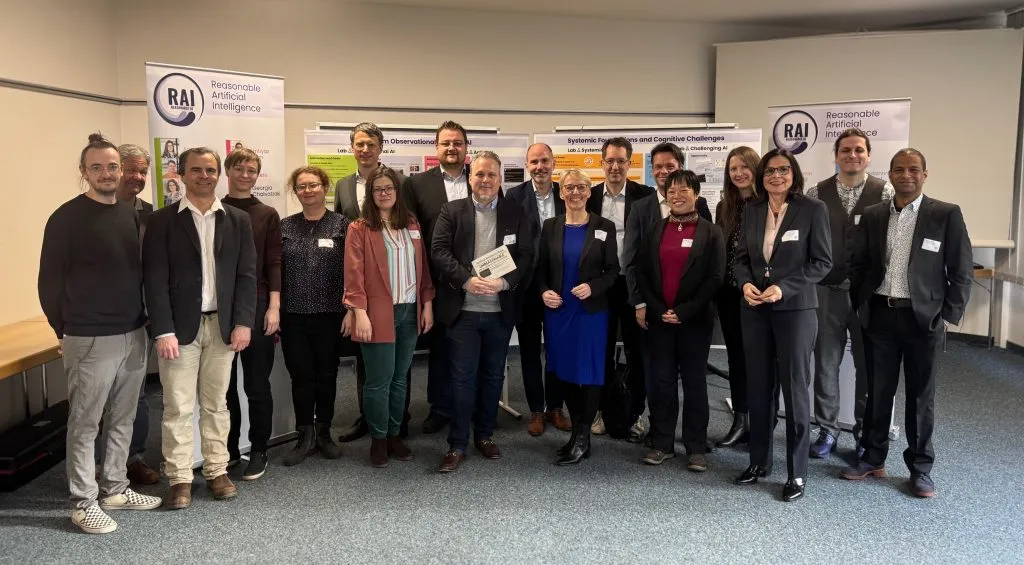
We are very happy and proud to be part of the team within the newly funded cluster of excellence “RAI: Reasonable Artificial Intelligence”!

RAI has succeeded in a prestigious and highly competitive process through the Excellence Strategy of the German federal and state governments. The cluster is headed by TU Darmstadt as the lead institution with research principal investigators at participating institutions: Julius Maximilian University Würzburg, Goethe University Frankfurt am Main, the University of Tübingen, the University of Saarland and the University of Bremen (the latter through our lab).

As implied by the name, the primary goal of RAI is to research a new generation of AI systems that learn in “reasonable” ways. In this context, “reasonable” refers not only to the current inability of AI systems to reason properly and employ common sense, but also their present unreasonable resource inefficiency, their inability to adapt adequately, as well as required improvements to become more reasonable in terms of socio-ethical outcomes. To this end, the RAI cluster focuses on advancing four pillars: Systemic AI, Observational AI, Active AI, and Challenging AI.

  • Systemic AI: This area focuses on the development of software and system methods that will enable RAI systems to be trained efficiently and support their integration into existing systems.
  • Observational AI: This research area focuses on contextual learning and brings together different AI concepts to provide RAI with a good level of common sense.
  • Active AI: This area focuses on continual and adaptive lifelong learning with active exploration so that RAI systems are able to adapt better.
  • Challenging AI: This research area develops measurement and evaluation methods (benchmarks) that can be used to evaluate and improve the performance of RAI systems.

We are very proud to be part of this excellence cluster and look forward to intense 7 years of innovative research to drive the next generation of AI. Find out more about RAI (opens in a new tab).

14 May · Paper

Our paper "BOWL: A Deceptively Simple Open World Learner" got accepted at CoLLAs 2025

Read more: Our paper "BOWL: A Deceptively Simple Open World Learner" got accepted at CoLLAs 2025

Our work “BOWL: A Deceptively Simple Open World Learner” has just been accepted at the Fourth Conference on Lifelong Learning Agents (CoLLAs 2025). Congratulations to our PhD candidate Roshni Kamath, not only for this acceptance, but also for getting two papers accepted in sequence, following the recent success of our ConCon paper at ICML!

As implied by title, we introduce a very strong baseline for Open World Learning. Such a baseline has previously been missing in the field of Open World Learning - a challenging undertaking in Machine Learning that aims to simultaneously i) detect whether data points belong to known or unknown tasks, ii) whether data points that are novel and belong to the task a model is trying to solve are informative, and iii) continually learn from new informative data points. Individually, each objective is challenging and the sub-fields of “out-of-distribution detection”, “active learning” and “continual learning” are trying to address aspects in isolation. A standard machine learning model typically suffers from catastrophic failure modes across each of these dimensions, making regular machine learning impractical for real-world application. While there exist complex ways to enable open world learning in the literature, in BOWL, we show that any deep neural network that contains batch-normalization layers can directly be turned into a very effective open world learner! To this end, we leverage the statistics tracked by batch-normalization and formulate rigorous mathematical mechanisms based on the learned Gaussian distributions to address the individual functions required for the model to interact with an open world. Overall, BOWL is thus a lightweight monolithic approach that easily turns a deep neural network significantly more robust, equips it with effective memory management, and the ability to adapt rapidly.

For more information, read the full paper (opens in a new tab).

8 May · Paper

Our paper "Scaling Probabilistic Circuits via Data Partitioning" got accepted at UAI 2025

Read more: Our paper "Scaling Probabilistic Circuits via Data Partitioning" got accepted at UAI 2025

Our work “Scaling Probabilistic Circuits via Data Partitioning” has just been accepted at the 41st Conference on Uncertainty in Artificial Intelligence Conference (UAI). Congratulations to first-author Jonas Seng and all co-authors!

In the paper we provide a unified framework for federated learning across different settings of heterogeneous data. To this end, we introduce federated circuits to bridge horizontal (clients’ data distributions differ), vertical (clients hold different features), and hybrid (both of the former) federated learning. Federated circuits reframe the federated learning problem as aggregation of distributions learned by each client on its data partition, rather than aggregation of model parameters. In an instantiation using probabilistic circuits, we show that sum nodes help us address horizontal federated settings through mixture distributions, whereas vertical federated settings are addressed through mixtures of products of independent clusters. Check out the full paper for the precise framework, training algorithm, and application examples on images and tabular datasets (based on credit fraud and breast cancer detection)

For more information, read the full paper (opens in a new tab).

2 May · Paper

Our paper "Where is the Truth? The Risk of Getting Confounded in a Continual World" got accepted as a spotlight at ICML 2025

Read more: Our paper "Where is the Truth? The Risk of Getting Confounded in a Continual World" got accepted as a spotlight at ICML 2025

Our paper “Where is the Truth? The Risk of Getting Confounded in a Continual World” got accepted at the_ International Conference on Machine Learning (ICML)_ 2025 and was selected as a poster spotlight (given to the top 2.6% of all submissions). Big congratulations to shared first authors Roshni & Florian and all co-authors for this achievement.

In the paper, we introduce a new important phenomenon to study in lifelong & continual learning: continual confounding. In continual confounding, “distracting” features appear and disappear over time and can lead to learned solutions being inadequate, even if a continual learning algorithm manages to accumulate all knowledge. That is, even with full memory of all past data, the sequential nature of confounders poses a significant challenge. A challenge, for which we introduce a new framework and dataset called ConCon. In the paper we show that models trained on ConCon succeed when training on all data, but sequential training on accumulated tasks fails without further action! We hope that this new setting inspires conception of a new generation of continual learning algorithms - algorithms that go beyond a simplified narrative that simply accumulating all knowledge over time is beneficial.

For more information, read the full paper (opens in a new tab).

April 2025

7 Apr · Welcome

Kajaree Das has joined as a PhD candidate

Read more: Kajaree Das has joined as a PhD candidate

We are more than happy to welcome Kajaree Das as a new PhD candidate in the OWL-ML lab.

Kajaree has previously completed a master’s degree in computer science at University of Bonn and has worked as a Software Developer in the industry before joining us as a doctoral researcher. In her master’s thesis, she worked on Unintended Bias Mitigation in Toxicity Detection using ML algorithms, a topic which will continue to inspire her during her future journey. During the PhD, Kajaree will focus on the interaction between lifelong machine learning and participatory AI - investigating dimensions of the ability to adapt effectively that may aid in achieving broader inclusion. We are looking forward to inspiring future research.

March 2025

4 Mar · Welcome

Malte Schwerin has joined as a PhD Candidate

Read more: Malte Schwerin has joined as a PhD Candidate

We are more than happy to welcome Malte Schwerin as a new PhD candidate in the OWL-ML lab.

Malte Schwerin has previously completed a master’s degree in computer science at RWTH Aachen. For his master’s thesis, he visited UBC in Vancouver for four months, working on robust ranking methods for algorithm competitions. In his PhD, Malte Schwerin will focus on integrating neuro-scientific findings of how the brain learns into lifelong machine learning. We are looking forward to inspiring future research.

November 2024

19 Nov · Opportunity

Hiring 2 fully-funded PhD Candidates - Deadline Dec. 10

Closed · deadline was 10 Dec 2024
Read more: Hiring 2 fully-funded PhD Candidates - Deadline Dec. 10

We are hiring two fully-funded PhD candidates to build up the new OWL-ML lab at the University of Bremen. The deadline for applications is December 10th, 2024.

The positions are not tied to a specific project and have the flexibility to pursue topics surrounding lifelong machine learning of interest to the group. Overall, these fall into the categories of sustainable, adaptive, robust, and inclusive AI/ML. Example topics are:

  • Continual learning
  • Knowledge transfer
  • Memory
  • Dynamic neural architectures
  • Learning from heterogeneous data streams
  • Neuro-inspired lifelong learning
  • Intentional forgetting and unlearning
  • Ethical considerations and AI system remediation
  • Participatory AI practice

18 Nov · Welcome

OWL-ML is moving to the University of Bremen

Read more: OWL-ML is moving to the University of Bremen

We are delighted to announce that Martin Mundt has accepted the position of full professor for Lifelong Machine Learning at the University of Bremen (opens in a new tab).

Consequently, the lab will relocate to form the Open World Lifelong Machine Learning (OWL-ML) group in Bremen from January 2025. The lab’s focus will remain on researching adaptive, sustainable & inclusive AI in continuation of its quest towards lifelong machine learning.