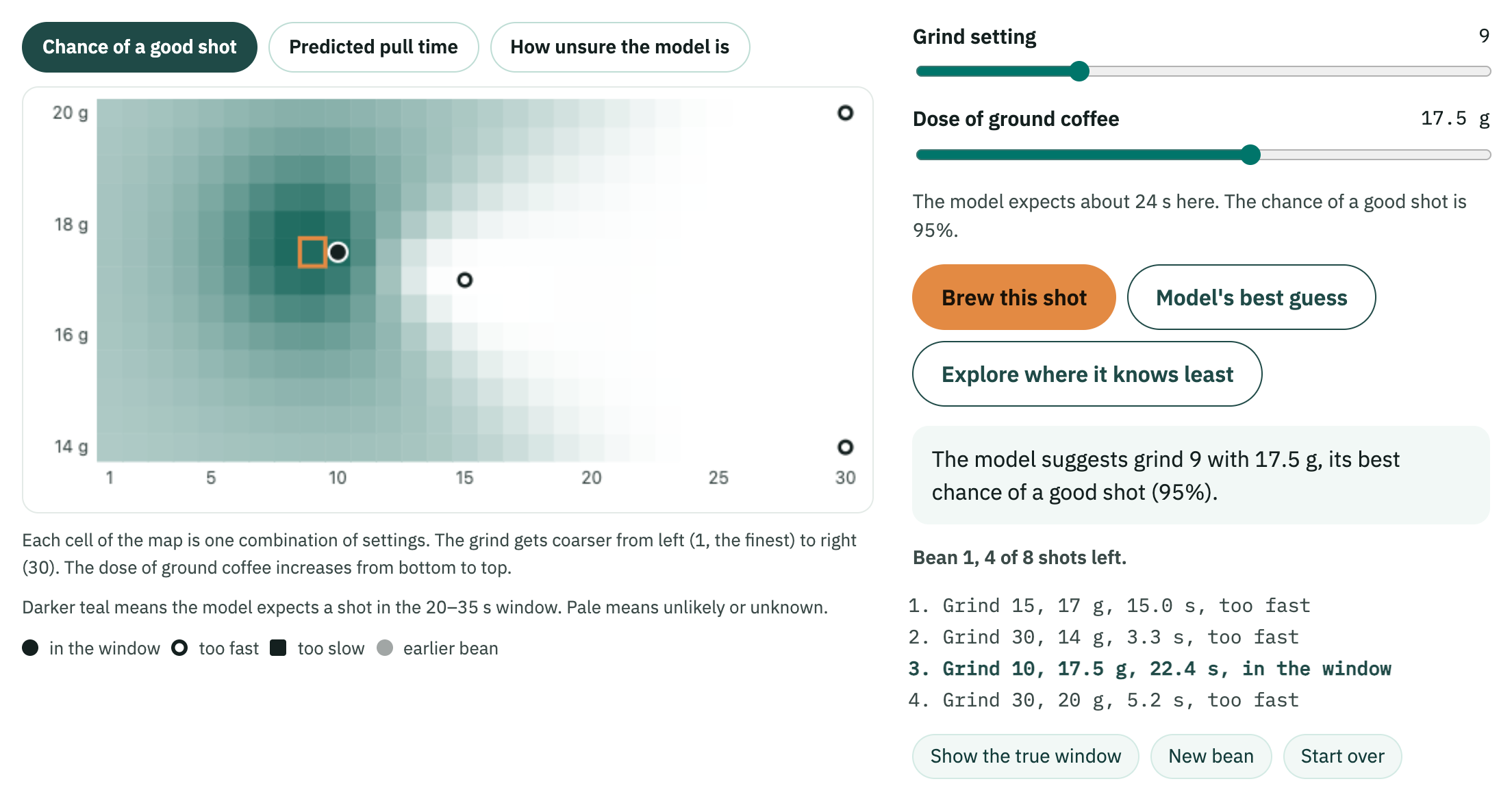
Dialing in an espresso means finding the grind setting and the amount of coffee that give a good shot. This demo treats it as a machine learning problem. A small model learns from every shot you brew and predicts how other settings would turn out. It then suggests what to try next, either where it expects a good shot or where it is least certain.
The interactive demo needs JavaScript.
What you are observing. The grinder and espresso machine are simulated. Only their directions are real. A finer grind or more coffee makes a slower shot, and no two shots are quite the same. A pull of 20 to 35 seconds with about twice the dose in the cup is a common rule of thumb.
The model. A Gaussian process predicts the pull time for every setting from the shots so far and says how sure it is. Its best guess aims for the highest chance of a good shot. Exploring goes where it is least sure. After a new bean, earlier shots count only as rough hints.
In the project. In the MOCCA project, students build this loop with real hardware. A camera first reads the bean package. The grinder and the espresso machine then brew a shot, which a Bluetooth scale measures. Machine learning models running on a small NVIDIA Jetson board use these measurements to suggest the settings for the next shot. We look at this through the lens of continual learning, with integrated feedback loops on taste assessments and the individualization of brewing preferences.