News archive

News from before the lab moved to the University of Bremen in November 2024.

November 2024

8 Nov · Event

We are launching the ConCon Challenge at the Continual Causality Bridge!

Read more: We are launching the ConCon Challenge at the Continual Causality Bridge!

In addition to our call for papers (opens in a new tab) at our third bridge on Continual Causality at AAAI-25 (opens in a new tab) we are launching the Continual Confounding: ConCon Challenge (opens in a new tab)!

In the ConCon challenge participants can submit contributions to solve one of two (or both) challenging scenarios surrounding the newly found phenomenon of continual confounding. In continual confounding, the difficulty extends beyond the traditional continual learning problem of catastrophic forgetting. Instead, task performance additionally deteriorates because each task is uniquely confounded! That is, even with a full memory of all past data, the sequential nature of confounders in ConCon poses a significant challenge - where joint training on all data succeeds, sequential training on accumulated tasks fails without further action!

Submission can be made until January 7th 2025 and all details can be found on the ConCon challenge’s Kaggle website (opens in a new tab). The most performant and innovative contributions will be invited to present their solutions at the AAAI bridge, whereas two highlighted contenders will further be awarded with a free bridge/lab/tutorial AAAI-25 registration.
October 2024

22 Oct · Event

The Continual Causality Bridge is back for round 3

Read more: The Continual Causality Bridge is back for round 3

we are happy to co-organize the third edition of the Continual Causality bridge at AAAI-25! Continual Causality is a** full two-day event **(25+26th of February 2025 at AAAI-25 in Philadelphia, USA): a “bridge” with the aim of bringing together the research fields of continual learning and causality. Beyond scientific advance, one primary goal is to provide a space for learning, discussions, and to connect and build a diverse community. The activities range from traditional tutorials on the educational side, invited vision talks and contributed ones based on submitted papers, to interactive sessions related to a novel hosted challenge, a speakers panel and community breakout discussions.

For full information, please visit https://www.continualcausality.com (opens in a new tab) , where the scientific motivation, bridge format, speakers & tutorials, program, and organizers are detailed. On the webpage, you can also find a link to join our Continual Causality Slack, so that we can already start growing together prior to the first event!

Finally, if you are eager to dive in and participate, there is also a broad call for participation/papers available: https://www.continualcausality.com/ (opens in a new tab) Until November 25th, 2024 (AOE), we invite 4 page submissions for both a proceedings and non-archival track.

For further questions, please feel free to visit the Continual Causality website (opens in a new tab).

July 2024

30 Jul · Paper

”Distribution-Aware Replay for Continual MRI Segmentation” accepted at PILM-MICCAI 2024

Read more: ”Distribution-Aware Replay for Continual MRI Segmentation” accepted at PILM-MICCAI 2024

Our paper “Distribution-Aware Replay for Continual MRI Segmentation” got accepted the_ Workshop Personalized Incremental Learning in Medicine_ at MICCAI 2024, with proceedings to be published in Lecture Notes in Computer Science (LNCS), Springer.

In the paper, we demonstrate that a small generative model (a variational autoencoder), that is trained to learn the latent distribution of a medical UNet, can equip the system with both continual learning and out-of-distribution detection capabilities. This in turn helps to make the system more robust and learn over time in the presence of sensor, patient population, or task shifts.

For more information, read the full paper (opens in a new tab).

May 2024

14 May · Award

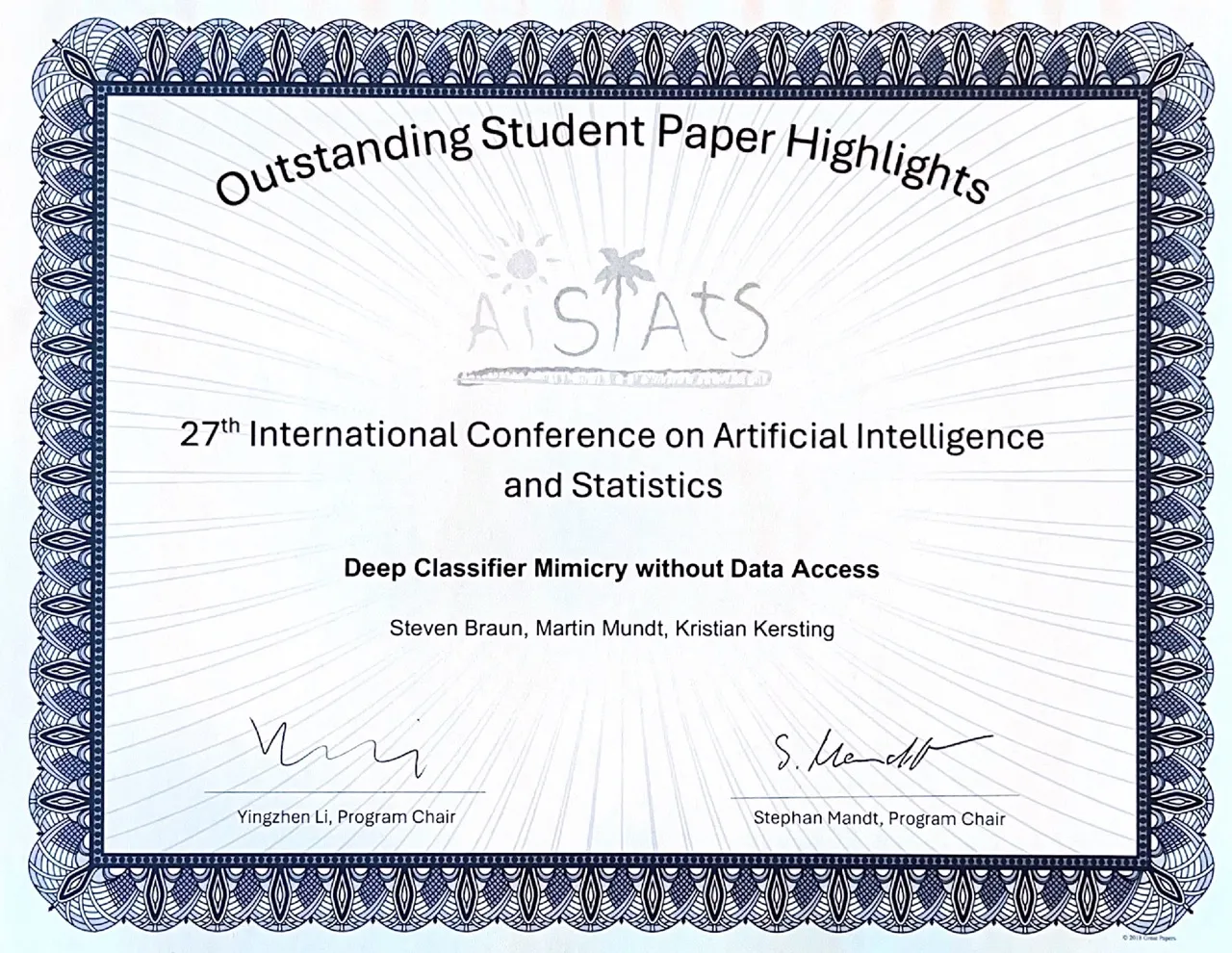
We received the AISTATS 2024 outstanding student paper highlight

Read more: We received the AISTATS 2024 outstanding student paper highlight

We are very honored and grateful that our paper “Deep Classifier Mimicry without Data Access” has received an Outstanding Student Paper Highlight award at AISTATS 2024.

In the paper, we introduce a method to distill a deep classifiers knowledge without making assumptions on model structure and without requiring access to original data. You can read the full paper at this link (opens in a new tab).

10 May · Paper

"Masked Autoencoders are Efficient Continual Federated Learners" accepted at CoLLAs 2024

Read more: "Masked Autoencoders are Efficient Continual Federated Learners" accepted at CoLLAs 2024

Our paper _“Masked Autoencoders are Efficient Continual Federated Learners” _got accepted for publication at the Conference on Lifelong Learning Agents (CoLLAs) 2024!

In the paper we investigate the challenging task of unsupervised continual learning in federated (distributed) scenarios. Our key motivation is that even if clients across a network don’t share the exact same goal, they will likely profit from the experience that other’s have made and should be able to listen to it and selectively choose beneficial parts. To this end, we show that masked autoencoders are particularly amenable to the setup. We then show the masking strategy can be integrated with task attention mechanisms and how this helps in selective knowledge transfer between clients.

For more information, read the full paper (opens in a new tab).

January 2024

22 Jan · Paper

Our paper "Deep Classifier Mimicry without Data Access" got accepted at AISTATS 2024 as an oral presentation

Read more: Our paper "Deep Classifier Mimicry without Data Access" got accepted at AISTATS 2024 as an oral presentation

Our paper “Deep Classifier Mimicry without Data Access” got accepted at the International Conference on Artificial Intelligence and Statistics (AISTATS) 2024. We are honored to have been selected for an oral presentation!

In the paper, we present a method for data-free and model-agnostic knowledge distillation. The essence of knowledge distillation is to train a model from scratch to mimic an already trained one, i.e. extract its knowledge. When we speak of data-free knowledge distillation, we mean that we do not rely on having access to any original or real data at all, that is we do not know what the model was trained on, only what it was trained for. When we speak of model-agnostic knowledge distillation, we mean we also don’t assume the model to follow a particular structure, so we do not craft solutions by e.g. mimicking a specific internal layer or accessing its representations. We show that for classifiers, we can create such a knowledge distillation process through diffusion and contrastive learning. We call the respective method CAKE: contrastive abductive knowledge extraction. In summary, we diffuse pairs of random synthetic noise examples to attract each other until they just barely fall on two different sides of a decision boundary. Colloquially speaking, we try to empirically “cover” the decision boundary as closely as possible, without the need to mirror the original training data distribution.

For more information, read the full paper (opens in a new tab).

17 Jan · Paper

"Adaptive Rational Activations to Boost Deep Reinforcement Learning" accepted as spotlight at ICLR 2024

Read more: "Adaptive Rational Activations to Boost Deep Reinforcement Learning" accepted as spotlight at ICLR 2024

Our paper “Adaptive Rational Activations to Boost Deep Reinforcement Learning” was accepted at the International Conference on Learning Representations (ICLR) 2024. We are honored to have been selected for a spotlight presentation!

In the paper, we present how a plug&play alternative to current activation functions - the rational activation function - a parameter efficient way to boost any neural network’s plasticity. At the hand of reinforcement learning benchmarks, we demonstrate that this plasticity leads to the model reaching higher accuracy as a consequence of its increased adaptivity, while at the same time mitigating the overestimation problem observed in e.g. Deep (Double) Q-Learning. We additionally confirm, on some popular image classification tasks, that we can reach higher, or similar accuracy at a much lower overall parameter count when using rational activations.

For more information, read the full paper (opens in a new tab).

December 2023

12 Dec · Event

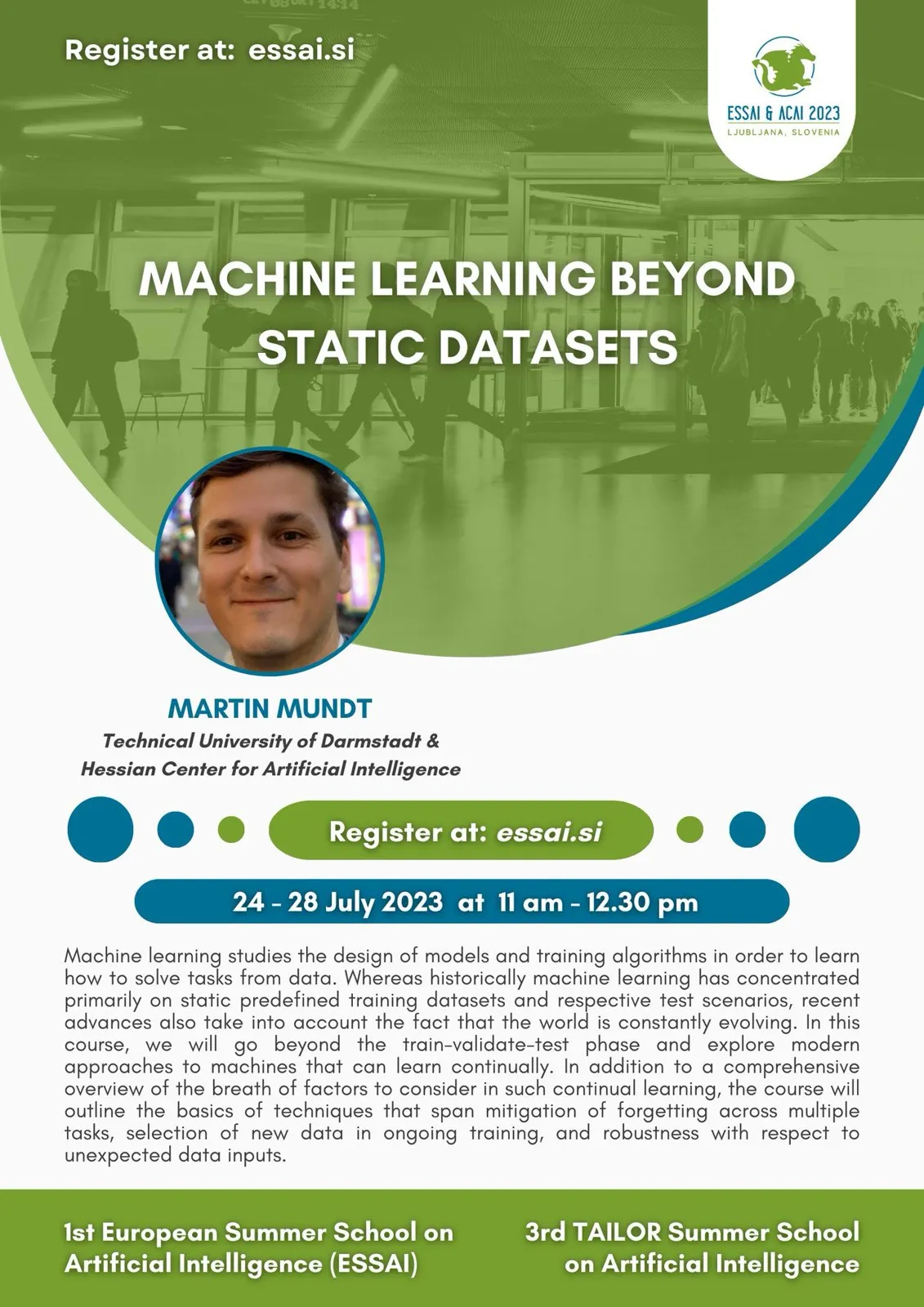
ESSAI23 course "Machine Learning Beyond Statics Datasets" recordings now publicly available

Read more: ESSAI23 course "Machine Learning Beyond Statics Datasets" recordings now publicly available

Following the in-person European Summer School on AI (ESSAI) in Ljubljana, Slovenia from July 24-28. 2023, the recordings for the 5-day course on “Machine Learning Beyond Static Datasets” have now been made publicly available. Watch this free course to learn how to transcend the traditional static train-test ML focus & move to the central elements underlying lifelong learning: http://videolectures.net/ESSAIandACAI2023_mundt_machine_learning/ (opens in a new tab)

November 2023

1 Nov · Welcome

Qi Li joins as research assistant for project CAIMAN

Read more: Qi Li joins as research assistant for project CAIMAN

We are delighted to welcome Qi Li as a research assistant in the OWLL group. In the process of working on her Master’s degree, Qi will spend the next year exploring continual learning models for climate within the recently granted project CAIMAN: “Continual Artificial Intelligence Models for Atmospheric Convection in Subtropical Regions”.

Intended as an early catalyst, CAIMAN’s central guiding question is the development of climate models that can continuously adapt to and monitor the different aspects of atmospheric convection to predict severe weather conditions. We are excited for Qi to contribute to this vision!

October 2023

30 Oct · Paper

"Designing a Hybrid Neural System to Learn Real-world Crack Segmentation from Fractal-based Simulation" accepted at WACV 2024

Read more: "Designing a Hybrid Neural System to Learn Real-world Crack Segmentation from Fractal-based Simulation" accepted at WACV 2024

Our paper title “Designing a Hybrid Neural System to Learn Real-world Crack Segmentation from Fractal-based Simulation” has been accepted for publication at the Winter Conference on Applications of Computer Vision (WACV).

The paper tackles the challenging real-world task to semantically segment cracks in concrete infrastructure. However, rather than relying on an abundance of manually labeled data, the paper overcomes the hurdle of manual annotation and fragile data-driven learning in low-data regimes by leveraging expert knowledge and simulation. As such, it first introduces a fractal-based physics based simulation pipeline for data generation, and then combines a deep learner on this data with a topological pit estimator to exploit domain knowledge. The resulting system learns exclusively through simulation, yet is shown to beat state-of-the-art approaches that are trained on a variety of real-world data in respective real-world concrete segmentation tasks.

For more information, read the full paper (opens in a new tab).

June 2023

23 Jun · Award

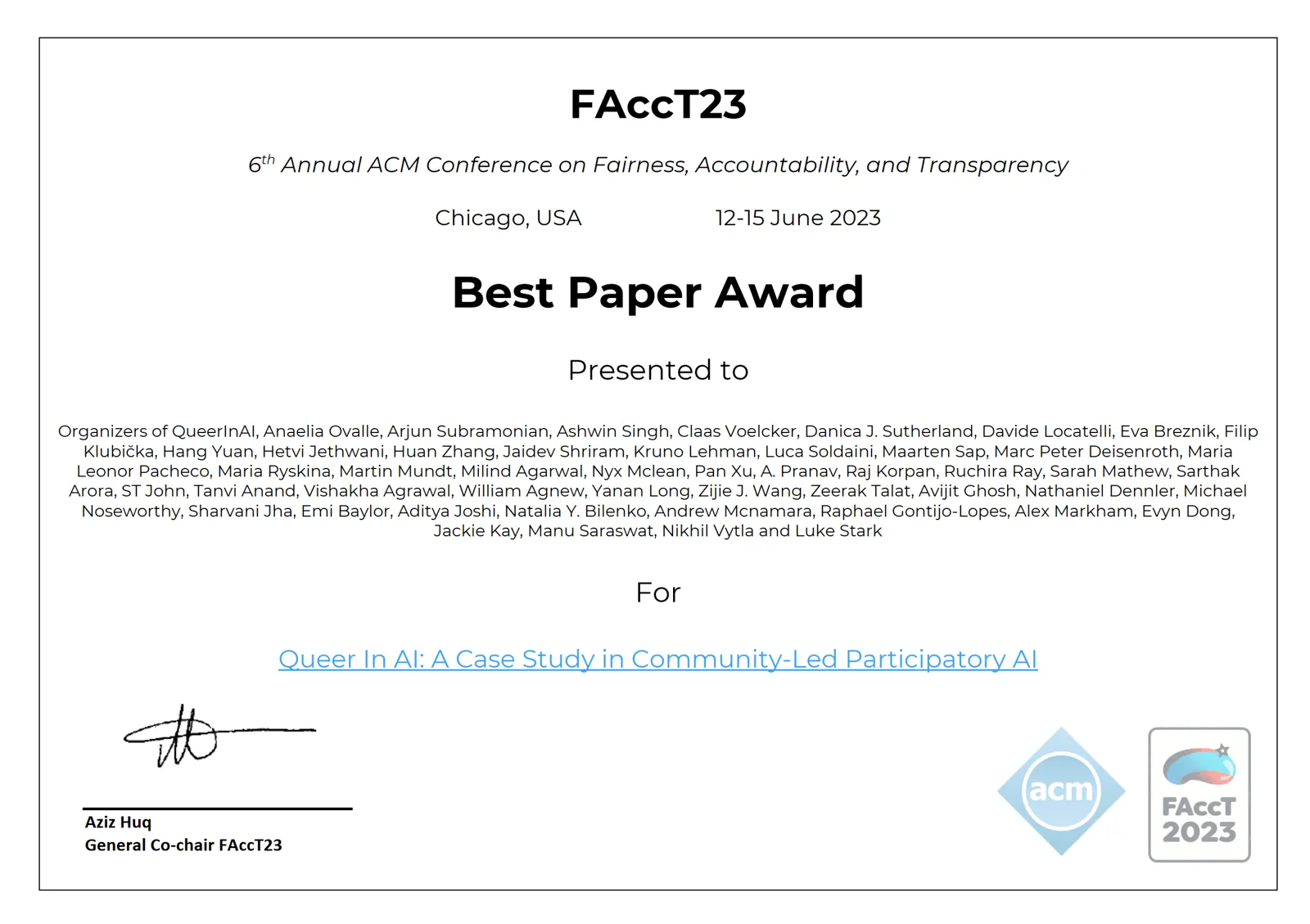
"Queer in AI: A Case Study in Community-led Participatory AI" receives ACM FAccT 2023 best paper award

Read more: "Queer in AI: A Case Study in Community-led Participatory AI" receives ACM FAccT 2023 best paper award

The recently accepted Queer in AI paper titled “Queer in AI: A case Study in Community-led Participatory AI (opens in a new tab)” has received the **best paper award **at the ACM Conference on Fairness, Accountability, and Transparency (ACM FAccT) 2023.

7 Jun · Paper

Continual Causality PMLR proceedings & retrospective paper are out

Read more: Continual Causality PMLR proceedings & retrospective paper are out

The proceedings, Proceedings of Machine Learning (PMLR) Volume 208 (opens in a new tab), are now publicly available for the AAAI-23 Continual Causality bridge (https://www.continualcausality.com (opens in a new tab)).

Proceedings include close to a 100 pages of content that initiates a first bridge between continual learning & causality research. As a special foreword, the organizers have written a retrospective paper (opens in a new tab) to summarize the event, trends, and discussions for those who were not able to participate:_ “Continual Causality: A Retrospective of the Inaugural AAAI-23 Bridge Program”; Mundt, Cooper, Dhami, Ribeiro, Smith, Bellot, Hayes. _

1 Jun · Paper

"Probabilistic Circuits That Know What They Don't Know" accepted with oral presentation at UAI 2023

Read more: "Probabilistic Circuits That Know What They Don't Know" accepted with oral presentation at UAI 2023

Our paper titled “Probabilistic Circuits That Know What They Don’t Know” has been accepted for publication at the Uncertainty in Artificial Intelligence (UAI) conference 2023 and has been selected for a 25 minute oral presentation.

The paper draws inspiration from the overconfidence phenomenon in neural networks, where false predictions on unknown concepts generally appear with a very large associated confidence in the (false) output. The paper first shows that this problem persists in probabilistic circuits, despite the models’ tractability. It then posits that this is due to a lack of uncertainty assessment in its probabilistic formulation. As a remedy, a closed-form solution to the popular Monte-Carlo dropout is derived, which provides an efficient assessment of uncertainty in the parameters in a computationally efficient way.

For more information, read the full paper (opens in a new tab).

May 2023

31 May · Event

Announcing the 1st Continual AI Unconference

Read more: Announcing the 1st Continual AI Unconference

We are pleased to announce the Call for Papers (to be published in PMLR) and Call for Talks for the upcoming ContinualAI Unconference (opens in a new tab) (CLAI Unconf). Organized by the non-profit research organization, ContinualAI (opens in a new tab), the conference seeks to accelerate inclusive and sustainable progress in our academic community through a unique, open-access, multi-timezone, 24-hour event which will be free to attend. The event will connect ideas beyond static datasets at the crossroads of machine learning, computational neuroscience, robotics, and more. **Stay up to date by visiting our webpage: **https://unconf.continualai.org (opens in a new tab)

Please note the following important dates:

Different from traditional conferences, CLAI Unconf allows you to

1) Preregister your ideas with accepted papers published in PMLR (Call for Papers (opens in a new tab))

2) Share an idea with the experts in the field with a 5 to 15 minute talk (Call for Talks (opens in a new tab))

We are currently inviting original contributions that delve into the dynamic aspects of AI, straying from the static train-test paradigm prevalent in much of the current AI research. The conference themes include, but are not limited to:

  • Navigating complex data collection systems
  • Understanding and describing continuous streams of data
  • Lifelong learning processes and generalization of knowledge beyond a specific target
  • Discovering new concepts in changing environments and handling partially observable information from potentially disparate data sources
  • Interdisciplinary perspectives on related topics
  • A more detailed account of the conference themes is available in our Call for Papers (opens in a new tab).

CLAI Unconf offers a unique experience with features such as:

  • Free for everyone
  • Easy accessibility through virtual, multi-timezone support
  • Contributed talks and pre-registration articles
  • Active roundtables encouraging participant interaction and discussions
  • Hands-on sessions promoting collaborative work and creativity
  • Mentoring Sessions

In addition, we offer an exciting pre-registration submission process to ensure scientific excellence (a more detailed account of pre-registration is provided in our Call for Papers). Researchers are invited to present well-articulated ideas and thoroughly outlined experimental protocols. These ideas will be evaluated and discussed during the conference, with follow-up findings published in CLAI Unconf’s Proceedings of Machine Learning Research (PMLR).

We believe this conference provides a unique opportunity to exchange ideas and explore new concepts in the field of Artificial Intelligence. We look forward to receiving your submissions and meeting you at the un-conference!

24 May · Paper

"Queer in AI: A Case Study in Community-led Participatory AI" accepted at ACM FAccT 2023

Read more: "Queer in AI: A Case Study in Community-led Participatory AI" accepted at ACM FAccT 2023

In collaboration with the Queer in AI community, a paper titled “Queer in AI: A Case Study in Community-led Participatory AI” has been accepted for publication at the ACM Conference on Fairness, Accountability, and Transparency (ACM FAccT) 2023.

As implied in the title, the paper treats Queer in AI as a case-study to examine how participatory design has shaped and continues to influence efforts over the years, together with what challenges exist and persist. For more information, read the full paper (opens in a new tab).

April 2023

19 Apr · Event

"Machine Learning Beyond Static Datasets"Course at European Summer School on AI

Read more: "Machine Learning Beyond Static Datasets"Course at European Summer School on AI

We are excited to present a 5-day course on “Machine Learning Beyond Static Datasets” as part of the European Summer School on AI (ESSAI) in Ljubljana, Slovenia from July 24-28. Join the course to learn how to transcend the traditional static train-test machine learning focus and move all the way to the central elements underlying lifelong learning.

The description and schedule for a plethora of interesting other courses, together with the ESSAI registration, can be found on the website: https://essai.si (opens in a new tab)

18 Apr · Event

Continual Machine Learning Course - Summer 2023

Read more: Continual Machine Learning Course - Summer 2023

The Continual Machine Learning Course is starting on April 14th 2023 and will contain an overall 14 lectures to learn all about machine learning beyond assumptions of a static world. Following an updated outline on last year’s iteration, we will cover important elements spanning popular transfer learning, selection of data in active learning, avoiding forgetting in sequential learning tasks, all the way to learning curricula, robust prediction on future data and the pitfalls and prospects of evaluation.

Recorded lectures are available on YouTube (opens in a new tab) based on last year’s live-stream. The lectures themselves won’t get re-recorded just yet. However, follow this year’s updated course for a major addition in the form of new exciting programming tutorials!

January 2023

31 Jan · Paper

"A Wholistic View of Continual Learning with Deep Neural Networks" paper now in Neural Networks 160

Read more: "A Wholistic View of Continual Learning with Deep Neural Networks" paper now in Neural Networks 160

Our paper titled “A Wholistic View of Continual Learning with Deep Neural Networks: Forgotten Lessons and the Bridge to Active and Open World Learning” is now published in Neural Networks, volume 160, Pages 306-336.

This paper is a comprehensive 30 page resource to both survey & start unifying views for new and old continual learners alike. It starts with a comprehensive survey of continual learning, active learning and open set recognition. It then outlines synergies and native interfaces beyond the typical catastrophic forgetting. To facilitate understanding, we outline a concrete instantiation of a neural network based model to combine the paradigms. Through a set of teaching examples, we then illustrate how this helps with avoiding forgetting, while being robust to unseen unknown data inputs in inference, being able to pick new data points to train on, handle corrupted & perturbed examples, and even optimize task curricula (if this is permitted/accessible by the available data input). We then use these insights to extend the existing definitions of continual learning, so that future work can strive to be more comprehensive.

For more information, read the full paper (opens in a new tab).

30 Jan · Event

AAAI-23 Queer in AI

Read more: AAAI-23 Queer in AI

We are very excited that Martin Mundt is co-chairing and organizing the Queer in AI diversity & inclusion event at the AAAI 2023 conference: https://www.queerinai.com/aaai-2023 (opens in a new tab)

Queer in AI’s presence at AAAI 2023 aims to create a safe and inclusive casual networking and socializing space for LGBTQIA+ individuals and allies involved with AI. We aim to create a community space where attendees can connect with each other, bond over shared experiences, and learn from each individual’s unique insights into AI, queerness, and beyond!

The meeting will take place in-person at AAAI-23 on February 10th, 2:00 PM-5:00 PM EST (8:00 PM-11:00 PM UTC) and will be streamed virtually (by AAAI-23) for remote conference attendees. There will be three speakers: Jessie Finocchiaro, Michael Madaio, Alfredo Canziani, who will reflect on the diversity and inclusion of the AI community from 2:00-3:30 PM EST (8:00-9:30 PM UTC). The speakers will be followed and complemented by a 1.5 hour networking and discussion session for all attendees.

November 2022

18 Nov · Event

Martin Mundt will be part of the Queer in AI "Faculty & Queerness" panel at NeurIPS-22

Read more: Martin Mundt will be part of the Queer in AI "Faculty & Queerness" panel at NeurIPS-22

Martin Mundt will join Sara Beery, Shamini Kothari and Talia Ringer as a panelist in the NeurIPS 2022 Queer in AI Workshop (opens in a new tab) panel on “Faculty and Queerness” on November 28th.

The panel brings together a diverse group of queer faculty to discuss their experiences in the workplace. From navigating academia to being out in their department, panelists will share experiences and lessons on the same. The panel will also include discussions on inculcating inclusivity in the classroom.

October 2022

18 Oct · Event

AAAI-23 Bridge on Continual Causality

Read more: AAAI-23 Bridge on Continual Causality

we are extremely excited to be part of the organizer team in the newest effort in advancing the field: the **Continual Causality bridge at AAAI-23: **https://www.continualcausality.com (opens in a new tab)

Continual Causality is a** full two-day event **(7+8th of February at AAAI-23 in Washington DC, USA): a “bridge” with the aim of bringing together the research fields of continual learning and causality. Beyond scientific advance, one primary goal is to provide a space for learning, discussions, and to connect and build a diverse community. The activities range from traditional tutorials and software labs on the educational side, invited vision talks and posters, to a panel and breakout discussions. All materials will be publicly disseminated as a foundation for the community, and the respectively discussed ideas, challenges and prospects will be aggregated to foster continued exchanges beyond AAAI-23.

For full information, please visit https://www.continualcausality.com (opens in a new tab) , where the scientific motivation, bridge format, speakers & labs, program and organizers + advisors are detailed. On the webpage, you can also find a link to join our Continual Causality Slack, so that we can already start growing together prior to the first event!

Finally, if you are eager to dive in and participate, there is also a broad call for participation/papers available: https://www.continualcausality.com/ (opens in a new tab)

Until November 18th (AOE), we invite 2 page submissions that present positions & visions on linking continual learning & causality.

For further questions, please feel free to visit the Continual Causality website (opens in a new tab).

5 Oct · Event

Continual Lifelong Learning Workshop at ACML 2022

Read more: Continual Lifelong Learning Workshop at ACML 2022

We are very pleased to announce that we are co-organizing the workshop on Continual Lifelong Learning at the Asian Conference on Machine Learning (ACML 2022), this December in hybrid format! The physical conference will be held December 8-10th in Hyderabad, India: https://www.acml-conf.org/2022/ (opens in a new tab)

The workshop spans many topics related to continual lifelong learning. There’s a call for papers here (deadline 31 Oct): https://continual-lifelong-learners.github.io/cfp/ (opens in a new tab)

We have amazing invited speakers:

  • Balaraman Ravindran (Professor of Computer Science, IIT Madras, India)
  • Jonghyun Choi (Associate Professor, Yonsei University, South Korea)
  • Thang B. (Assistant Professor, Australian National University, Australia)
  • Joseph K J (PhD Student, IIT Hyderabad, India

Big thanks to workshop co-organizers: Siddharth Swaroop , Khimya Khetarpal , Peter Nickl , Lu Xu, Emtiyaz Khan.

Through the workshop, we hope to connect Asian researchers in this field together and to the rest of the world. Come join us!

4 Oct · Paper

"Elevating Perceptual Sample Quality in Probabilistic Circuits through Differentiable Sampling" paper out now in PMLR 181

Read more: "Elevating Perceptual Sample Quality in Probabilistic Circuits through Differentiable Sampling" paper out now in PMLR 181

Our formerly pre-registered paper called “Elevating Perceptual Sample Quality in Probabilistic Circuits through Differentiable Sampling” is finally out in the Proceedings of Machine Learning Research (PMLR), Volume 181, Pages 1-21.

The paper has started as part of the NeurIPS 2021 Preregister Science Workshop (opens in a new tab), where the fundamental idea is to first write a paper proposal with all details on hypotheses, methodology, and an experimental protocol. This initial version of the paper then underwent double-blind peer-review with respect to relevance, novelty and correctness, before we spent several more months on following up rigorously on empirical experiments. The final paper version was then reviewed again, to check if we have thoroughly followed our own experimental protocol and have correctly described both negative and affirmative outcomes in terms of our original hypotheses.

From a content point of view, the central idea of the paper is to introduce differentiable sampling into probabilistic circuits (PCs). Equipping PCs with this capability, allows us to include loss functions beyond traditional log likelihood optimization. This in turn allows for the inclusion of different loss functions, such as those commonly employed in generative adversarial networks (GANs), maximum mean discrepancy (MMD) or Variational Autoencoders (VAEs). The key hypothesis was that such inclusion of loss functions from neural network counterparts, could boost the perceived sampling quality of PCs, which has traditionally been seen as sub-par. Whereas there is still plenty of room for improvement in terms of employing engineering tricks, our final results indicate that such loss functions are indeed feasibly for training of probabilistic circuits. Our work now enables plenty of exciting future directions!

Check out the full paper (opens in a new tab) for more details.

1 Oct · Paper

"Return of the normal distribution: Flexible deep continual learning with variational auto-encoders" paper now in Neural Networks 154

Read more: "Return of the normal distribution: Flexible deep continual learning with variational auto-encoders" paper now in Neural Networks 154

Our paper titled “Return of the normal distribution: Flexible deep continual learning with variational auto-encoders” is now published in Neural Networks, Volume 154, Pages 397-412, October 2022.

In the paper we propose a novel two-stage variational auto-encoder approach to continual learning. Our approach comes with the advantage that previous assumptions in continual learning are optional, but can be accommodated if desired. Respectively, our proposed architecture allows for flexible choices to enable unsupervised, semi-supervised, or fully supervised continual learning. In essence, this fits into our view of continual learning: a framework should allow for flexible inclusion of additional assumptions, while arguably should not require strong simplifications per definition.

For more information, read the full paper (opens in a new tab).

July 2022

20 Jul · Welcome

Martin Mundt has joined the board of ContinualAI

Read more: Martin Mundt has joined the board of ContinualAI

Group leader Martin Mundt has joined the board of directors of the non-profit ContinualAI (opens in a new tab) organization for the election term of 2022-2024.

Following up on the last years’ successes of ContinualAI, the six board members will continue scaling up the organization’s efforts to facilitate public access to continual learning, organize events, provide lectures, seminar series, and further push the open-source Avalanche PyTorch library (opens in a new tab).

5 Jul · Welcome

Subarnaduti Paul has joined as a PhD candidate

Read more: Subarnaduti Paul has joined as a PhD candidate

We are more than happy to welcome Subarnaduti Paul as one of the first OWLL PhD candidates at TU Darmstadt & hessian.AI.

Subarnaduti Paul has previously successfully graduated from TU Munich in the summer of 2022, before starting the PhD with OWLL in July. His field of expertise lies in Electronic Systems & AI. He was also working as a Research Intern for the Innovation Lab at Bosch Rexroth. His Thesis was able to propose reliable solutions that can integrate deep learning into traditional industrial processes. He will bring his previous experiences to instill a new picture in the paradigm of Open World Learning.

June 2022

10 Jun · Welcome

Roshni Kamath has joined as a PhD candidate

Read more: Roshni Kamath has joined as a PhD candidate

We are more than happy to welcome Roshni Kamath as one of the first OWLL PhD candidates at TU Darmstadt & hessian.AI.

Roshni has previously worked as a Research Associate/AI Consultant at Forschungszentrum Jülich. She also worked as a Software Engineer before pursuing her Masters in Artificial Intelligence from Katholieke Universiteit (KU) Leuven.

April 2022

28 Apr · Event

Open World Lifelong Learning - A Continual Machine Learning Course

Read more: Open World Lifelong Learning - A Continual Machine Learning Course

We are beyond excited to share our newest effort in making continual machine learning accessible to the public: Martin Mundt will be presenting a 13 week long course titled “𝐎𝐩𝐞𝐧 𝐖𝐨𝐫𝐥𝐝 𝐋𝐢𝐟𝐞𝐥𝐨𝐧𝐠 𝐋𝐞𝐚𝐫𝐧𝐢𝐧𝐠 - 𝐀 𝐂𝐨𝐧𝐭𝐢𝐧𝐮𝐚𝐥 𝐌𝐚𝐜𝐡𝐢𝐧𝐞 𝐋𝐞𝐚𝐫𝐧𝐢𝐧𝐠 𝐂𝐨𝐮𝐫𝐬𝐞”, supported by hessian.AI (opens in a new tab) & the non-profit ContinualAI (opens in a new tab) organization.

The general focus of the course will be to provide a comprehensive overview of the breath of factors to consider when moving towards machines that learn continually.

Make sure to follow the course live on YouTube every Tuesday at 17:30 - 19:00 CEST: YouTube playlist (opens in a new tab)

The first lecture will be starting on May 3rd 2022. The YouTube recording will be persistent and remain watchable at later points in time.

18 Apr · Funding

Start of the OWLL group as a hessian.AI DEPTH junior research group

Read more: Start of the OWLL group as a hessian.AI DEPTH junior research group

The Open World Lifelong Learning (OWLL) Lab is officially starting in March 2022 as a DEPTH junior research group (Nachwuchsgruppe) within the Hessian Center for Artificial Intelligence (hessian.AI (opens in a new tab)) and the state-funded research-cluster The Third Wave of Artificial Intelligence (3AI (opens in a new tab)), both coordinated by Technical University of Darmstadt (TU Darmstadt (opens in a new tab)).

OWLL is led by Martin Mundt, who is also a postdoctoral researcher in TU Darmstadt’s Artificial Intelligence & Machine Learning (AIML (opens in a new tab)) Lab and will start off with funding for 2 PhD candidates (starting as soon as possible).

The research vision and objectives of OWLL are summarized on the home page.